
Last updated: August 7, 2026
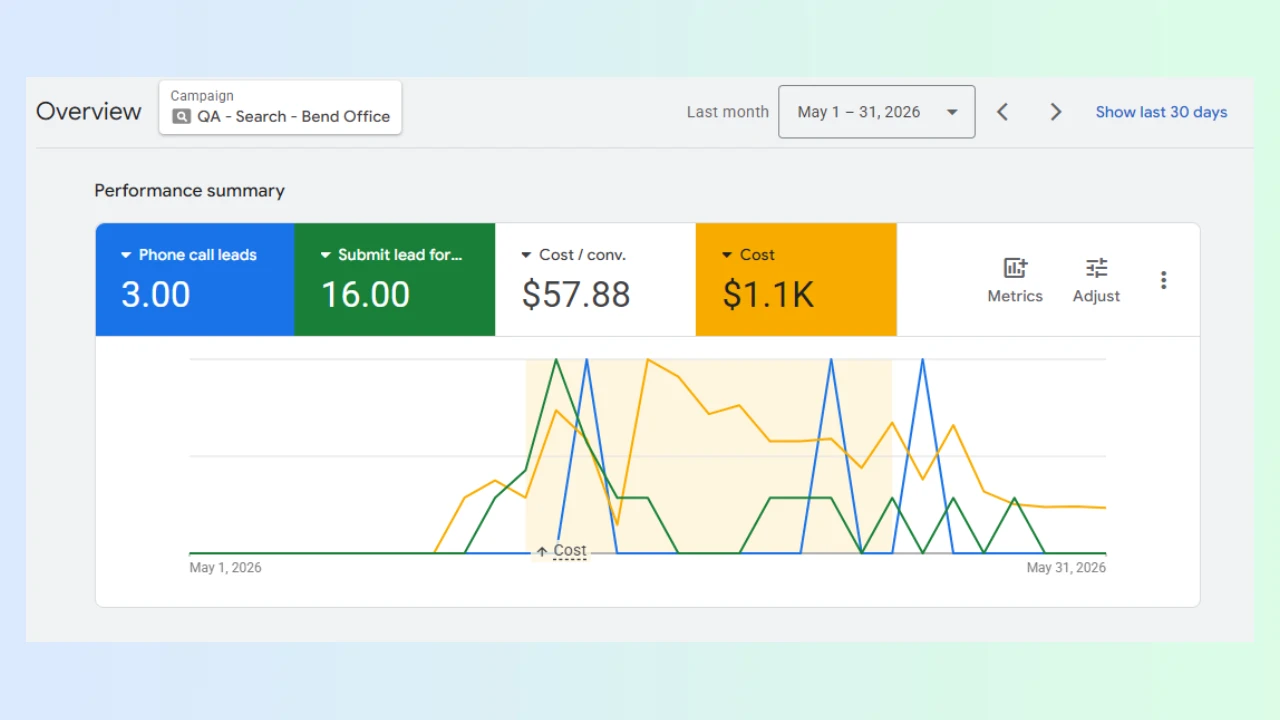
An Oregon therapy practice generated 19 new client inquiries in its first 30 days on Google Ads, spending $1,100 at an average cost of $57.88 per lead. The first inquiry arrived within the opening week. This page covers how the campaign was built, what was tracked, and what the numbers mean for a private practice weighing paid ads.
A private therapy practice operating out of Bend, Oregon, offering individual counseling for adults. The practice was new to paid advertising and had no Google Ads history, no conversion tracking, and no baseline for what a new client inquiry should cost.
Central Oregon is a smaller market than Portland or Seattle, which cuts both ways. Competition and click costs are lower. Search volume is also lower, so a campaign has to capture close to all of the available high-intent searches rather than skimming the best ones off a large pool.
Three problems needed solving before the first ad ran.
No conversion tracking existed. The practice could not tell which keywords, ads, or searches produced actual inquiries. Without that, every optimization decision is a guess, and Google’s automated bidding has nothing useful to optimize toward.
Therapy searches attract low-intent traffic. People searching for therapy worksheets, free counseling, licensure programs, therapist jobs, and insurance questions look identical to prospective clients at the keyword level. In a small market with a modest budget, that traffic drains a campaign fast.
The practice needed results quickly enough to justify continuing. A new practice spending its own money needs to see inquiries within weeks, not after a six-month ramp.
MentalHealthAds.com set up the full campaign, tracking, and optimization process. This is the same structure we use across our Google Ads for therapists accounts, adapted for a small-market practice.
We built a Search campaign targeting Bend and the surrounding Central Oregon area, with tightly themed ad groups by service and intent rather than one broad keyword list. Location targeting was set to presence only, so the campaign did not pay for clicks from people outside the service area.
Therapy keywords need filtering that generic PPC keyword research does not do. We built the keyword list around people looking for a therapist to see, and built the negative keyword list around everyone else: free counseling, worksheets, degree and licensure programs, job searches, crisis and hotline queries, and insurance plans the practice does not take.
The ads answered the questions a prospective client actually has before making contact: whether the therapist is accepting new clients, how soon an appointment is available, whether sessions are in person or virtual, and what the practice specializes in. No guarantees, no outcome claims, and nothing that violates Google’s healthcare and sensitive category policies.
We set up Google Tag Manager, phone call conversion tracking, and lead form submission tracking before launch, not after. This is the part most new accounts skip, and it is the part that determines whether the campaign can be improved at all.
In this account the split was 16 forms to 3 calls, which is unusual. Therapy clients tend to prefer the lower-commitment path of a written inquiry, while psychiatric patients call far more often. For comparison, our Los Angeles PMHNP case study shows 27 calls against 26 forms in the same period. If you serve both, track both, because the pattern is not predictable from the outside.
We reviewed the destination page for the elements that decide whether a click becomes an inquiry: a visible contact method, a short form, clear information about specialties and fees, and the answer to whether the therapist is accepting new clients. Related work is covered on our mental health website design page.
Every week we reviewed the search terms report and added negatives. In a small market with a $1,100 monthly budget, a handful of irrelevant clicks per day is a meaningful percentage of the spend.
| Metric | Result |
|---|---|
| Ad spend | $1,100 |
| Lead form submissions | 16 |
| Phone call leads | 3 |
| Total client inquiries | 19 |
| Cost per lead | $57.88 |
| Average inquiries per week | about 4 to 5 |
The first inquiry came in during the opening week, which confirmed the targeting and tracking were working before much budget had been spent.
Put against practice economics: a therapy client who stays for a course of weekly sessions is worth well into the four figures at typical private-pay Oregon rates. At $57.88 per inquiry, even a modest rate of inquiries that become booked clients leaves a wide margin.
Tracking came first, not last. Conversion tracking was live before the first click. Every optimization after that was based on real data instead of assumptions.
The negative keyword list did the heavy lifting. In therapy campaigns, deciding who not to show ads to matters as much as choosing keywords. This is the recurring weekly task that keeps cost per lead from drifting upward.
Small market, tight targeting. Bend does not have the search volume of Portland, so the campaign was built to capture high-intent local searches rather than to maximize impressions.
Correct structure from the start. A new account with clean structure and clean tracking can produce results in the first month. Most campaigns that take six months to work are being rebuilt during those six months.
How much do therapists spend on Google Ads? Most solo therapists and small practices start between $700 and $2,000 per month in ad spend. The Oregon practice in this case study spent $1,100 in its first month and received 19 client inquiries. Smaller markets need less budget than major metros to reach the same inquiry volume.
What is a good cost per lead for therapy Google Ads? It depends on the market. In smaller markets like Bend, Oregon, $40 to $80 per inquiry is a reasonable range. In large metros, expect $60 to $150. This campaign came in at $57.88 per inquiry.
How long does it take for Google Ads to work for a therapy practice? This campaign produced its first client inquiry within the first week and 19 inquiries in the first 30 days. That timeline is realistic when tracking and campaign structure are correct at launch. Accounts built without conversion tracking usually take several months, because the first months get spent fixing the setup.
Do therapy clients call or fill out a form? Most fill out a form. In this Oregon account, 16 of 19 inquiries came through the contact form and 3 came by phone. Psychiatric practices see the opposite pattern, with calls often exceeding forms. Track both regardless of which you expect.
Is Google Ads worth it for a small private practice? It can be, when the cost per inquiry stays well below the value of a client. At $57.88 per inquiry and a typical private-pay therapy client worth over a thousand dollars across a course of sessions, the math works with room to spare. It stops working when campaigns run without tracking, without negatives, or without anyone reviewing them weekly.
Can therapists advertise on Google without violating privacy rules? Yes. Campaigns need to be configured so no health information, appointment details, or identifying client data is passed to ad platforms. This is a setup decision, and it needs to be made before tracking goes live rather than corrected later.
MentalHealthAds.com manages Google Ads for mental health providers across the United States:
Book a free strategy call and we will review your market, estimate a realistic cost per inquiry for your area and specialty, and outline what a campaign would look like for your practice.
Results shown are from one client account for May 1 to May 31, 2026. Advertising results vary by market, budget, services offered, and practice capacity.
Get started with a free consultation. We’ll analyze your current marketing efforts and create a customized strategy for your practice.
info@mentalhealthads.com