
Last updated: August 7, 2026
A Los Angeles psychiatric mental health nurse practitioner generated 53 new patient leads in ten weeks on $2,940 in Google Ads spend, at an average cost of $55.51 per lead. This page breaks down how the campaign was built, what was tracked, and what the numbers looked like week to week.
The practice is a solo psychiatric mental health nurse practitioner in Los Angeles. A PMHNP is an advanced practice registered nurse licensed to assess, diagnose, and treat psychiatric conditions, including prescribing and managing medication. In California, PMHNPs handle a large share of outpatient medication management, which puts them in direct competition with psychiatrists and national telehealth companies for the same searches.
Before June 2026, the practice relied on directory listings, referrals, and word of mouth. Those channels worked, but volume swung month to month with no way to plan around it. The provider wanted a channel that produced a steady number of inquiries each week and could be increased or paused based on available appointment slots.
We launched the Google Ads campaign in June 2026.
Advertising psychiatric care in Los Angeles is harder than advertising most local services, for three specific reasons.
Search intent varies widely. Someone searching for a stimulant by name and someone searching “psychiatric nurse practitioner near me” are at completely different stages, and only one is likely to book. Broad keyword coverage in psychiatry burns budget quickly.
Los Angeles is one of the most expensive mental health ad markets in the United States. Local practices bid against hospital systems, national telehealth brands, and funded startups. A solo provider cannot win by outspending them, so the campaign has to win on relevance and waste control instead.
Most psychiatric inquiries arrive by phone, not by form. In this account, 27 of 53 leads came by phone. Practices that only track form submissions consistently undercount their results and let Google’s bidding optimize toward the wrong action.
We built one Search campaign for California with small, tightly themed ad groups instead of a single large keyword list. Each ad group covered one service and one intent: psychiatric evaluation, medication management, telepsychiatry, and provider-type searches such as “psychiatric nurse practitioner near me.”
Small ad groups let each ad match the exact search. That improves relevance, lowers cost per click, and keeps the account readable when it is time to optimize. This is the same structure we use across our Google Ads for psychiatrists accounts.
We bid highest in Los Angeles County and surrounding areas, then extended lighter coverage across California for telehealth searches. Location targeting was set to presence only, not presence or interest, so the account stopped paying for clicks from people outside California researching providers here.
If you run a California practice, our page on Google Ads for mental health practices in California covers the state-level targeting rules in more detail.
Before launch we applied a negative keyword list built from previous psychiatry accounts: job and salary searches, degree and certification programs, “free,” sliding scale, insurance plans the practice does not accept, controlled substance shopping terms, and pharmacy queries.
After launch we reviewed the search terms report weekly and kept adding. In psychiatry accounts, negative keyword work is the highest-return recurring task there is. It is the main reason this campaign’s spend stayed on people who could realistically become patients.
We tracked contact form submissions and phone calls separately, including calls from ads and calls from the website. This was the single most important technical decision in the account.
Phone calls made up 27 of the 53 leads, slightly more than half. Without call tracking, the campaign would have appeared to produce 26 leads on $2,940 in spend, a cost per lead of $113, and would likely have been cut before it matured.
Tracking was configured with patient privacy in mind. We do not pass health information, appointment details, or identifying patient data into ad platforms.
The ads answered what a prospective psychiatric patient wants to know before calling: whether the provider is accepting new patients, how soon an appointment is available, whether visits can be virtual, and whether a referral is required. We avoided guarantees, outcome claims, and medication-specific language that violates Google’s healthcare policies.
Mental health and psychiatric advertising falls under Google’s sensitive category and healthcare policies. We reviewed keywords, ad copy, and landing page content against those policies before launch. That review is why the account went live without disapprovals, which is where a large share of new psychiatry campaigns stall.
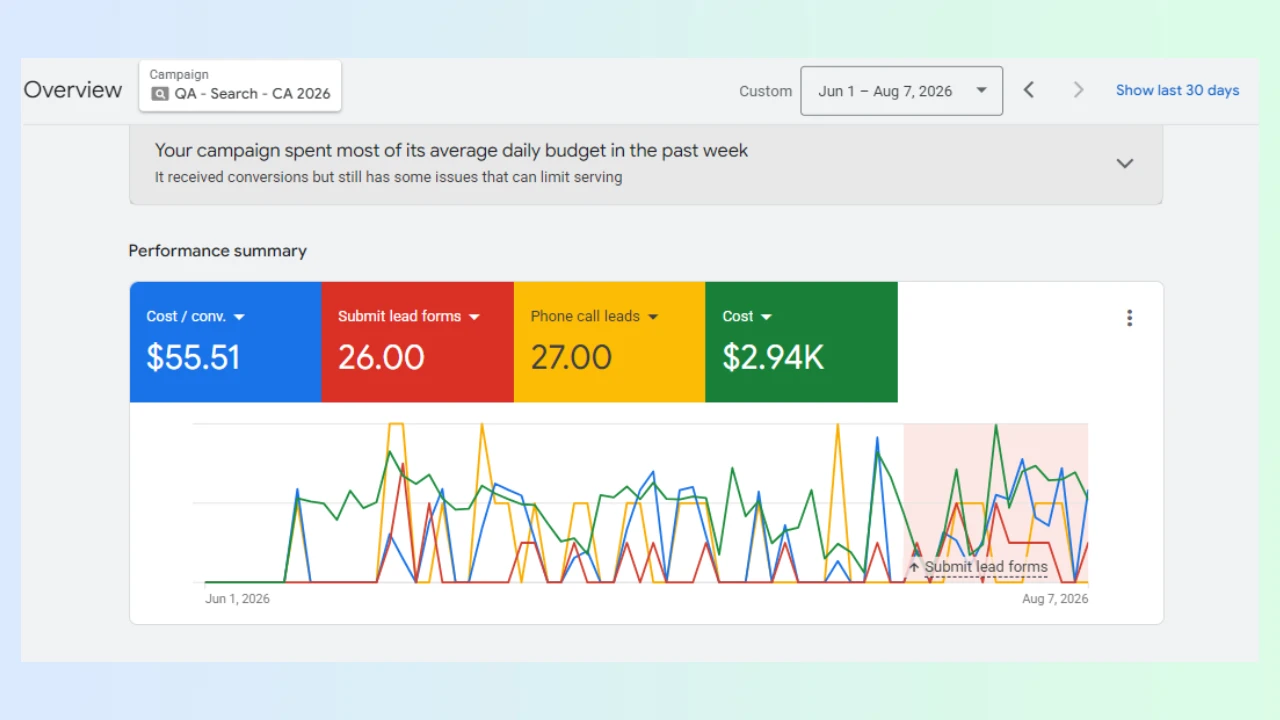
Between June 1 and August 7, 2026, the Los Angeles PMHNP campaign produced:
| Metric | Result |
|---|---|
| Ad spend | $2,940 |
| Lead form submissions | 26 |
| Phone call leads | 27 |
| Total patient leads | 53 |
| Cost per lead | $55.51 |
| Average leads per week | about 5 |
| Weekly ad spend | about $290 |
Performance was uneven in the first two weeks, which is normal while Google’s bidding collects conversion data. By July, weekly lead volume was steadier and the negative keyword work had removed most of the wasted spend visible in the June search terms report.
For context on the economics: psychiatric medication management patients typically return for follow-up visits over many months. Even at a conservative rate of inquiries that become booked patients, a $55.51 lead cost leaves a wide gap between what this practice pays for a lead and what a patient is worth over the course of care.
Set up call tracking before you spend a dollar. More than half the leads in this account came by phone. If you only track form fills, you will underreport your results and make budget decisions with half the data missing.
Narrow beats broad in expensive markets. A smaller keyword set with disciplined negatives produced better economics than wide coverage would have, particularly in Los Angeles.
Budget size is not what decides the outcome. This campaign ran on under $3,000 across ten weeks and still produced consistent lead flow. Structure, tracking, and weekly management mattered more than spend.
How much should a psychiatric nurse practitioner spend on Google Ads? Most solo PMHNPs and psychiatrists start between $1,000 and $2,000 per month in ad spend. The Los Angeles PMHNP campaign in this case study averaged about $1,250 per month and produced roughly 20 to 25 patient leads monthly. The right budget depends on your market, your service area, and how many new patients you can take on.
What is a good cost per lead for psychiatry Google Ads? In large United States metros such as Los Angeles, New York, and Chicago, $50 to $120 per lead is a common range for psychiatric services. The campaign in this case study came in at $55.51 per lead, at the strong end of that range.
How long does it take for a psychiatry Google Ads campaign to work? Expect two to three weeks of unstable performance while the campaign collects conversion data. Most psychiatry accounts we manage reach steady cost per lead in weeks four through six. This account followed that pattern, with June running rough and July stabilizing.
Can psychiatric nurse practitioners advertise medication management on Google? Yes, within limits. Google restricts prescription drug terms and certain healthcare claims, and some medication keywords cannot be targeted at all. Campaigns need to be built around those policies from the start, or they get disapproved.
Do psychiatric patients call or fill out forms? Both, and calls are often the larger share. In this Los Angeles PMHNP account, 27 of 53 leads came by phone and 26 came through the contact form. Any psychiatry campaign that does not track calls is measuring roughly half of its actual results.
Is Google Ads better than SEO for a psychiatry practice? They answer different needs. Google Ads produces patient inquiries within days, which is what this practice needed. SEO takes months to build but lowers your long-term cost per patient. Most established practices eventually run both. If you need patients this quarter, start with ads.
We build and manage Google Ads campaigns exclusively for mental health providers across the United States, including psychiatric nurse practitioners, psychiatrists, therapists, counselors, and group practices.
Get started with a free consultation. We’ll analyze your current marketing efforts and create a customized strategy for your practice.
info@mentalhealthads.com